

“We will be careful to distinguish speculation from fact.” -Carl Sagan, Cosmos
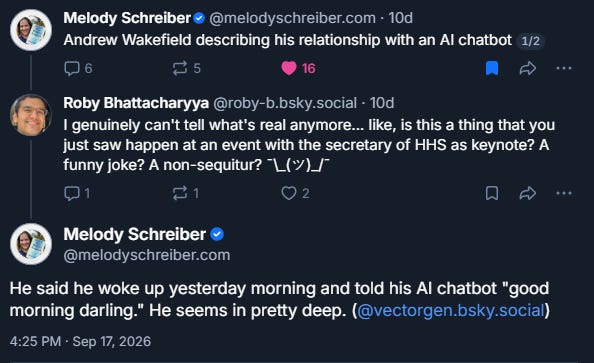
In the recent national “Children’s Health Defense” conference, godfather of the modern anti-vaccine movement and abuser of young children Andrew Wakefield admitted to being in love with a generative “artificial intelligence” chatbot: telling her “Good morning, darling.” This is an ongoing public health crisis unfolding across the most obnoxious faux-intellectual frauds that love to prattle on authoritatively about topics that they know quite little about. For example, here is journalist Taylor Lorenz’s video about professional athiest Richard Dawkin’s A.I. girlfriend:
Wakefield went on to introduce his longtime friend Robert F. Kennedy, Jr., who made further baseless claims about vaccines and the nation’s health, hot after further incentivizing violence against actual doctors & scientists on Trump’s behalf:
This is the level of collective obscenity that represents the modern anti-vaccine war on science. Getting all hot and bothered because an automated chatbot on your phone, not even a woman, or a man getting paid to pretend to be an attractive woman like many OnlyFans accounts, has fostered an intimate relationship with you. That is how repulsively unlovable Andrew Wakefield & his ilk are:
Anyways, what a great opportunity to talk about violent videogames!
How the World Failed to Face Its F.E.A.R.
Let’s rewind to the days of another horrific era in American politics: 2004. Critically acclaimed Raven Software publishes an instant classic of a new first person shooter videogame titled: F.E.A.R: First Encounter Assault Recon. A daring mix of The Matrix and The X-Files with a dash of The Ring, it winds up being one of the greatest first-person shooters ever made. Hiring one of the best and brightest out of MIT to program their enemy behaviors, you are met with bad guys improvising cover by flipping over tables, crashing their bodies through windows, and even coordinating flanking attacks against you. F.E.A.R. felt like it was realizing many of the promises that modern generative “artificial intelligence” claims to be.
Do you want to know what the sad legacy of such a lovely game is? Many fans of first person shooter games hated this sort of engagement. They hated being flanked. They hated enemies who didn’t thoughtlessly march into crosshairs, begging for cranial lead injections. The MIT programmer wouldn’t return for the sequels, and the franchise quietly faded away after F.E.A.R. 3 failed to impress.
So just why was the original F.E.A.R. so captivating? You always managed to scavenge up just enough bullets to get through the next firefight, especially when combined with the thrilling first person jumping roundhouse kicks that were absolutely devastating. Alongside the adaptative difficulty of the initial entries in the Max Payne franchise, these sorts of interactive behaviors posit the question: Does the computer know my feelings? Is it self-aware? Has it developed a form of intelligience that we all need to start being aware of?
Heck no. The MIT grad who programmed the enemy A.I. in F.E.A.R. developed an incredible logic system for individual entities in the game world to coordinate attacks & react to the player’s actions. In layman’s terms, a daisy chain of “if this, then do that” sort of statements made in code. That’s simply not sentience. I love the amazing work that team did in putting that game together; I don’t fetishize the masked goons who make up all the awesome gunfights in F.E.A.R. Everyone should give F.E.A.R. a go if they get a chance, you can readily find it on Good Old Games.
Here is my hot take: I fear that we are facing a generational crisis of people who may claim to be technologically inclined, but they simply refuse to form any tangible understanding of how “The Computer” actually works. They don’t want to try and make sense of why their amazing electronic device does the wonderful things that it does. Instead, they’d much rather inhabit a fantasy realm in which they’re telling themselves that an A.I. chatbot gave them an erection because it responded positively to the prompt “Good morning, darling.” The code is simply designed to remix other texts into generating a response that pretends to display affection towards you.
Wakefield’s Digital Romance

This is what brings us snapping wildly back to Andrew Wakefield. As Brian Deer writes in the devastating The Doctor Who Fooled the World, here is:
“a doctor without patients, but a teacher without students, not a scientist, but a zealot and opportunist.”
Wakefield refused to understand why what he did was so wrong, and instead fled to the United States to become an anti-vaccine celebrity with the help of dangerous crackpots such as Robert F. Kennedy, Jr. and Hollywood actor Robert DeNiro. Only to become a blueprint for future anti-vaccine crackpots such as the University of California San Francisco’s Vinay Prasad, who is now insisting that the COVID-19 vaccine killed children and his “evidence” was lost evil corrupt liberals at the Food & Drug Administration changed a report.
Wakefield has profited from terrorizing the parents of autistic children by falsely suggesting that they are to blame for their child’s condition by vaccinating them against horrible diseases that, to this day, still continue to kill Americans. More-so now thanks to the efforts of RFK Jr. and Andrew Wakefield. This speaks to just how truly despicable and unlovable Andrew Wakefield is, that he is now boldly professing his relationship to an “artificial intelligence” chatbot, which should really be called an automated remix software built on theft, because in Wakefield’s worldview? It’s good when we have a constant stream of children dying of vaccine preventable causes.
This steady stream of public health crises provides a fertile ground for him and all the other anti-vaccine grifters to attack the people who dedicate their lives to trying to prevent those agonizing deaths, whilst fleeing from journalists simply trying to do their job of verifying their outrageous claims. If public health was allowed to do its job, they’d be out of business and risk having to get a real job. Although to be frank, you shouldn’t trust someone like Wakefield to pump my gas, much less stock the shelves at the local grocery store.
The Gatekeepers of Knowledge
In the nightmare realm of Andrew Wakefield, Robert F. Kennedy, Jr. and their most loyal pestilence sycophants like Vinay Prasad, they don’t want you to actually understand anything. They want to lock up that actual knowledge and simply tell you what you’re allowed to believe. If we go back thousands of years to the time of the ancient Greeks, those in power decided that allowing the public to know of a secret fifth shape, the dodecahedron, was a danger to society.
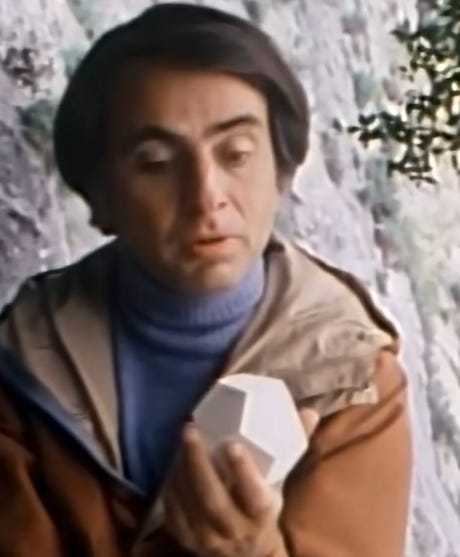
A gosh-darned shape! A government-classified shape! As much as I adore the 1998 Will Smith & Jeff Goldblum flick Independence Day - you can’t beat out the government concealing from the public knowledge of... a shape. Who wouldn’t want to see a film depicting the impassioned arguments insisting that we had to hide the knowledge of the dodecahedron from the general public?
Where Wakefield & his most dedicated associates will forever be recognized as a scourge, Carl Sagan’s legacy will forever live on to open the minds of generations that follow. While Wakefield simps a sycophantic A.I. chatbot, we can all go to the Internet Archive and pull out the first episode of Carl Sagan’s Cosmos, whose most passionate love was a multi-millennia old Library of Alexandria. Sagan is most truly heartbroken over the loss of such a wonderful archive of government seized books from thousands upon thousands of years ago:
Sadly, modern American science & medicine is presently undergoing its own burning of the Library of Alexandria. I wish a true hero of men such as Carl Sagan was still here to lead us out of this chapter. Alas, we must conjure our own solutions to such existential challenges to life as we know it.
