

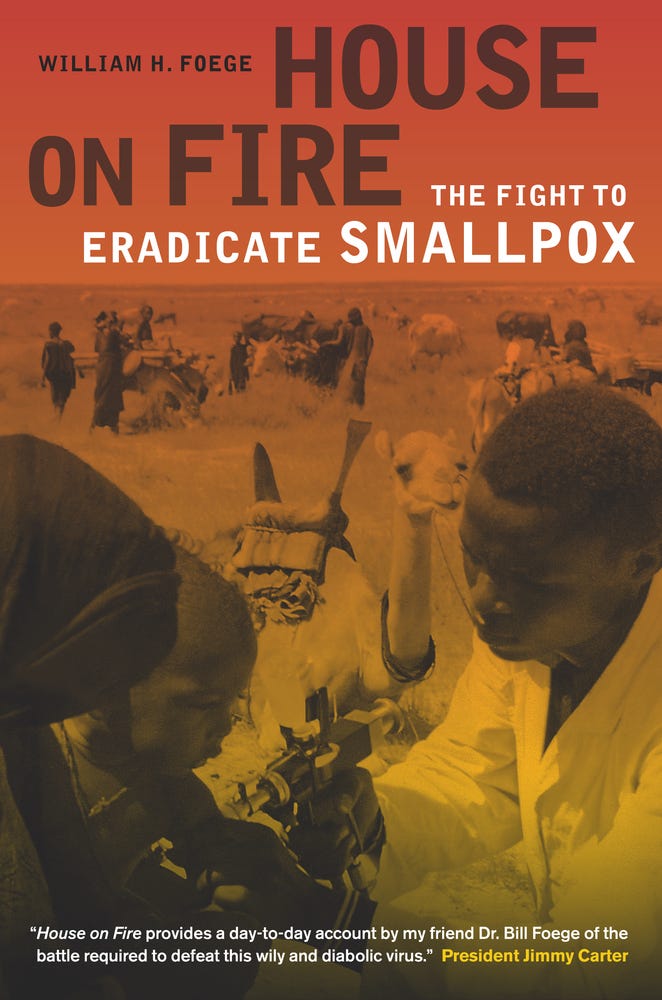
House on Fire: The Fight to Eradicate Smallpox is written by William H. Foege and was published by University of California Press in 2011. You can find it wherever books are sold.
“People rarely reflect on the fact that they have not had to deal with smallpox, tuberculosis, whopping cough, diphtheria, rabies, or other controlled maladies in their lifetimes.”
-William H. Foege
The Millennial generation was born into a world of which they owe a great deal to those who came before: Just years earlier, a massive international coalition had come together to finally eradicate smallpox from the world. They will never know or see this horrible virus beyond what is read in history books and old photographs. The horrible puss-filled sores, the permanent scarring, the blindness, and death that smallpox left in its wake is now but a distant memory.
On the other hand, the generation being born today is inheriting a world in which a rising tide of unchecked pestilence threatens us all. Reactionary arsonists spewing dangerous myths have compromised the public square, fooling adults into turning a blind eye towards widespread disease outbreaks amongst children, starting with COVID-19 and moving on to measles, as well as other diseases. In response, liberals and progressives have offered little more than a collective shrug.
“A person suddenly transformed by the vision of what was possible could not be stopped.” -William H. Foege
The optimistic ambition that drove William H. Foege and his colleagues in a massive international coalition to eradicate smallpox from the Earth is long forgotten. The measures that the Centers for Disease Control and Prevention (CDC), World Health Organization (WHO), and others deployed in the 1960s and 70s are now totally unthinkable if they were needed today. Childish arsonists are gleefully celebrating the smoldering embers of what it took to save millions.

House on Fire is an incredible globe-spanning adventure, featuring motorcycles, political intrigue, civil war, and all the other elements of a grand Oscar-winning blockbuster. It’s also an enlightening look at the traditions and attitudes that we need to return to if we are to beat back the larger anti-vaccine war against science and the public’s health. We owe Foege and his compatriots, heroes to the world, a great deal of gratitude. Instead, our culture celebrates posting garbage to social media.
“One could not work at CDC without deeply internalizing the idea that disease control requires accurate knowledge about the disease and its environment and that this knowledge is obtained through surveillance systems.” -William H. Foege
While smallpox and COVID-19 are obviously two very different diseases, it’s worth reading House on Fire to compare and contrast the attitudes between the two responses. How did one succeed in eradicating the virus from the world, while another has the public shrugging their shoulders as the virus became responsible for what is now the leading chronic illness in children? Does collective apathy serve any benefit beyond preserving our fragile egos?
Everything Old is New Again
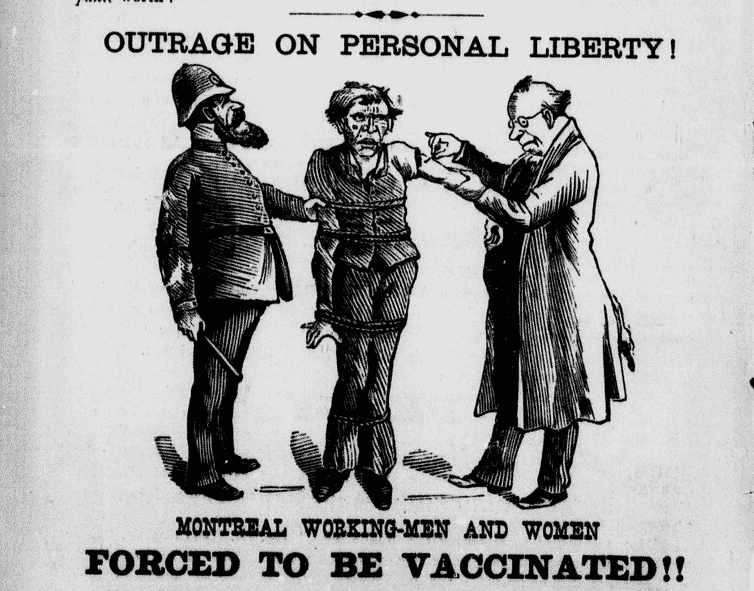
You can go back centuries and find political cartoons demonizing Edward Jenner’s revolutionary smallpox vaccine, as well as vaccine mandates. These reactionary myths followed us all the way on to the COVID-19 pandemic and the mRNA vaccines which saved millions of lives. As the campaign to eradicate smallpox began to come together in the 1960s, Foege notes that there were many doubters, who insisted such a goal was impossible and a waste of money and time.
Here in America from the very beginning of the COVID-19 pandemic, there was no shortage of voices telling people to just give up and surrender to the virus. In a 2023 Time magazine editorial, a former Exxon executive writing for the “COVID Collaborative” (featuring Chris Christie, Tom Ridge, Ashish Jha, and Monica Gandhi) insisted that we need “New courageous “accept exposure” policies” targeting the last third of Americans still protecting themselves from a virus that had killed and disabled so many. Many are still sick with Long COVID, suffering with no treatment or cure. Reactionary attitudes, driven by an uncaring wealthy elite, became tragically endemic amidst a torrent of epidemic waves.
“It also demonstrated a second important law for successful collaborations: the need to suppress egos and seek satisfaction in a shared outcome rather than holding individual power or protecting turf.” -William H. Foege
When we contrast the attitudes of COVID-19 disinformation artists like Vinay Prasad, Jay Bhattacharya, Marty Makary, and others with the writing of Foege on his smallpox experiences, you notice a number of things missing from House on Fire. William doesn’t engage in childish name calling or expletive filled rantings, instead dedicating his literary real estate to heaping praise upon so many of his colleagues and their important contributions. Instead of minimizing or misrepresenting the virus, Foege calmly walks through an explanation of how smallpox functions and what it’s capable of. Whereas the former celebrated the apathy and impotency of the individual, the latter believes in our collective potential for great achievement.
You might be shocked to learn that at no point does the great labors Foege and his team embarked upon in their global crusade feature writing a useless online petition. They didn’t advise young people to seek out the virus or celebrate outbreaks amongst schoolchildren. They didn’t produce media mocking and insulting those who sought to protect themselves or their loved ones from the virus. This coalition vaccinated millions, treated patients in the hospital, and placed the infected under mandatory quarantine. Y’know, actual work.
Aspirational Defeatism
Had the reckless saboteurs of the COVID-19 response been in charge, the world would likely still be facing the threat of smallpox while these frauds paraded themselves in the media as heroes of “medical freedom” or some other garbage. They would continue to blather nonsense minimizing the virus as simply a bad rash, while refusing to admit when their obvious errors are pointed out by scientific research. Unfortunately, the dominant attitudes of our federal public health agency leadership is to celebrate nonsensical blathering over tangible achievement as “MAHA Wins.”
“Yet even as the smallpox program was finally showing obvious success, there were still attacks on the surveillance/containment strategy. Most of them involved people voicing criticism or doubt in talks or in conversations with the intent of undermining confidence, and they could be ignored.”
-William H. Foege
It’s worth restating that smallpox and COVID-19 are two wildly different diseases, yet both are caused by viruses transmitted from person to person. Foege and his colleagues’ goals were highly ambitious, with victory far from guaranteed. Was the answer to simply throw their hands in the air and give up at the first sign of difficulty? History clearly proves not.
The half century between the 1970s and the 2020s saw the rise of the home computer, dialing into a BBS, the World Wide Web, and soon social media. The engine of disinformation that had been attacking public health for centuries found itself supercharged, with mainstream media outlets all too eager to help pour the kerosene. A whole field of journalists who never considered pandemics or public health prior to 2020 became overnight epidemiologists yet found themselves too paralyzed to inquire as to the validity of absurd claims.
Fearmongering about “ZeroCOVID” caricatures, non-pharmaceutical interventions, and the precautionary principle of public health ran abundant, while not nearly as much energy was spent decrying the minimizing rebranding of SARS-CoV-2 with terms like “inevitable seasonal yuck,” as coined by Emma Green in The New Yorker. Many don’t want to admit they were bamboozled by the same Biden who said Iraq had “weapons of mass destruction” and claimed Theranos was the “laboratory of the future.” Siezing upon this moment of weakness, the anti-vaccine war on science laundered their talking points into the more liberal mainstream. Now we are left totally unprepared should another public health crisis emerge on our shores.
“Smallpox was a shared risk, and its removal required a shared effort. In the years since them, other problems - nuclear arms, polio, SARS, HIV, H1N1 flu (surrogates for an alien invasion) - have confirmed the power of understanding shared risks.”
-William H. Foege
Can you even begin to imagine the CDC of today sending officials overseas to fight infectious disease outbreaks abroad? Dedicated surveillance systems, often going door to door delivering vaccines, and mandatory quarantines to contain & prevent said outbreaks should they happen here at home? These are massive government interventions. Howling jackals would be screeching bloody murder! Worse yet, with the demolition of the Environmental Protection Agency and the acceleration of climate collapse, of which pandemics such as COVID-19 are a side effect of, we are left much more vulnerable than before.
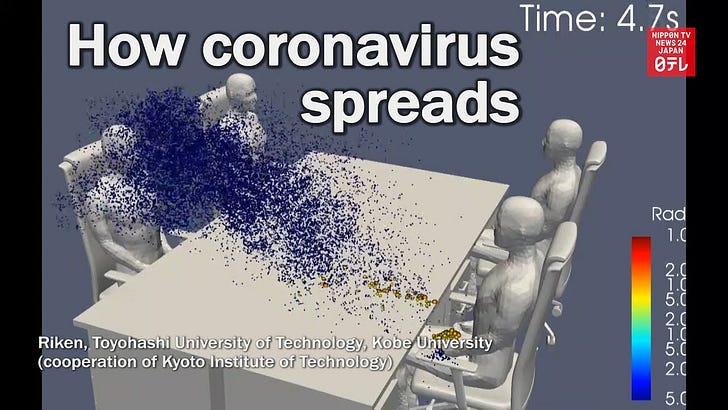
We see the beginnings of it now as schools across America regularly shut down due to infectious disease outbreaks, many of them caused by airborne viruses. While the anti-vaccine war on science cheers and profits from sick and suffering children, the liberal principles that contributed to the global effort to eradicate smallpox have largely been abandoned. Meanwhile, the already developed & effective solutions to prevent transmission of airborne viruses in schools and other public places lay sitting on a shelf, unused and collecting dust:
Moving Forward Together
It wasn’t simply the vaccine that defeated smallpox (of which it was highly effective and played a major role), but the combination of the vaccine and non-pharmaceutical interventions including mandatory quarantines. The vaccine-only strategy for COVID-19 failed millions of Americans who were led to believe they’d done everything right: they’d gotten vaccinated, they quit masking, they got infected, and they either died of a breakthrough death or developed Long COVID induced disability and/or chronic illness. This needless sacrifice conferred no meaningful electoral success to the Democrat Party and failed to placate the anti-vaccine war on science. Can we finally go back to practicing the humility shared by William H. Foege and his fellow public health heroes now?
“This is a cause-and-effect world, and smallpox disappeared because of a plan, conceived and implemented on purpose, by people. Humanity does not have to live in a world of plagues, disastrous governments, conflict, and uncontrolled health risks.”
-William H. Foege
With the reckless demolition of our federal public health agencies, whatever comes into power after Trump is going to have to have a serious plan to rebuild, and I don’t mean “restoring trust” by kotowing to the screeching and hollering of ignorant jackals. A great first step would be a public commitment to prevent the transmission of viruses in our schools and hospitals. Second, a renewed pledge to crack down on the crooked charlatans that make up the anti-vaccine war on science. Thirdly, an understanding that do-nothing yappers are not a role model to aspire to. Most important of all, we can’t let crooked billionaires sabotage public health initiatives.
We can only turn the tide by reviving the principles that brought about real positive change to the world. William H. Foege’s House on Fire is essential reading if you truly want to understand just how much we’ve lost in just a few short years and how can begin to rebuild. The alternative is surrendering to a reactionary apathy to the infectious viruses which offers us nothing but needless suffering.
House on Fire: The Fight to Eradicate Smallpox is written by William H. Foege and was published by University of California Press in 2011. You can find it wherever books are sold.
