


We’ve talked before about the problem of COVID Contrarianism from Pandemic Pundits: the Yap-From-Home Enthusiast Epidemiologists, the people who think you treat sick patients via Substack posts and Youtube livestreams, etc. With the PAI roster lacking a real doctor or qualified medical expert, but instead having dedicated thousands of hours to various videogames over the past three decades, we feel just as qualified to comment on “the discourse” as Kevin Bass, who was recently featured on Fox News alongside Tucker Carlson, as well as the PAI.
We at the Pandemic Accountability Index would like to present a poorly researched, completely unorthodox oral history of why some of the very worst of the pro-viral pundits are suffering from a crippling addiction that influences their writing, leading them to give the public dangerous information. This is an epic tale that begins nearly twenty years ago, in a faraway land… a land known as… Azeroth.
For free subscribers, here is a preview of the dangerous labyrinth which awaits:
World of Warcraft Conquers the World of Earthcraft
bing pr0n haul
One Weird Trick! To Make Your Life an Unyielding & Endless Nightmare
If You Die in the Game, You Die for Real
Diagnosing The Pandemic Pundit
Please consider upgrading to a paid subscription in order to support our work and enjoy this article. If you’d prefer to make a one-time donation via Paypal, you can do so - then reach out to us via Twitter and we’ll DM you a link.
PART 1: World of Warcraft Conquers the World of Earthcraft
November 2004: Acclaimed videogame developer Blizzard releases World of Warcraft, a “Massively-Multiplayer-Online-Roleplaying-Game” that at it’s peak, had 12 million subscribers, paying $14.99 a month to play. To over-simplify the rules and mechanics, you spend most of your time right mouseclicking your character through a fantasy landscape, and mash different orders of the F1 through F12 keys to deploy various spells and abilities in order to vanquish your enemies. Your eyes are stimulated with a constant dripfeed of numbers - whether its monsters dying or your stats going up - as well as dressing up in new armor or robes, to a degree that there’s even an entire Subreddit dedicated to the practice. You’re essentially on a content treadmill with no hard failstate, hit with an unending stream of visual indicators that you are making progress in one form or another, triggering a dopamine release and positive feelings. It’s easy to see how this could quickly become addictive, with all of the negative consequences that follow.
The game became an overnight global phenomenon. People spent hundreds, no, thousands of hours playing - to the degree that there have been many stories of children dying after their parents abandoned them, choosing instead to crusade across Karazhan or whatever. This was how deeply addictive World of Warcraft was - the constant stream of visual feedback as you made forward progress towards an “endgame” was incredibly intoxicating. As long as you put in the manhours, success was guaranteed - by the designers of the game, of course. You got to feel like a heroic protagionist, slaying monsters and going on epic quests across the land, and that sense of adventure as you mouseclicked and macro’d across the realm, crushing all of the obstacles that stood before you.
Some will argue that culture is downwind of politics. Others say that the reverse is true. I would argue that it’s a little more complicated, and here is a bold, unprovable hypothesis: did the millions of collective manhours dedicated to becoming the most powerful Undead Warrior or Pandaren Warlock in a fantasy realm affect people’s brain chemistry and outlook on the real world? Did this make them more susceptible to the “Just World” fallacy? This is a cognitive bias in which one believes that bad things only happen to people that deserve it, and good things happen to me because I’m a good person which deserves what I have.
I believe this might be true, and my single strand of evidence, stretched incredibly thin, is the presidential election that soon followed.
PART 2: bing pr0n haul

The 2008 Presidential Election, which many remember as when America finally elected somebody who wasn’t a white man to the Oval Office. There was a fascinating curiosity as well, in which there was a surge in support for the Libertarian Ron Paul who was running for the Republican nomination - who very much championed this just world fallacy and promised to make the government stop taking away your hard-earned gains. I mean, just imagine if the government of Azeroth went around demanding some percentage of your hard-earned gold, to fund flying airships to serve as public transit! Suggesting that you didn’t earn that shiny epic mace all on your own, that your “Clan” is entitled to some of that loot? Absolute hogwash, my liege!
There were many memes as well, such as “pr0n haul 2008: K1LL Y0UR PAR3NTS” or any number of David Dees political cartoons - some of which were filled with horrific antisemitic imagery. There’s also a fantastic short story about a day in the life of a police officer in a libertarian’s ideal utopia - because libertarianism is a bunk ideology that essentially replaces the public’s State with a corporate, privately owned State that lets the middle class and well-off pretend that they are a heroic protagonist of World of Earthcraft, the MMORPG with literal billions of subscribers - they simply can’t stop playing! Ron Paul supporters were sold a fantasy, much like the fantasy they enjoyed in the game that dominated their lives, and it influenced their real-world ideals to an embarrassing degree. You can actually set your watch by how quickly a libertarian begins yammering about the need to lower age-of-consent laws.

At the same time, we were seeing the beginning of the modern era of social media, as the wild frontier of the Internet was being consolidated into just a few networks - Twitter, Youtube, etc. - and many of the developers of these centralized hubs have or had spent a considerable amount of time playing World of Warcraft, or other MMOs - totally off topic, but does anyone else remember Auto Assault? That wasn’t just a fever dream of a post-apocalyptic car combat RPG? No? Just me? Oh well. - and this influenced the design of these centers of discourse. In fact, there was an entire school of thought around it: called gamification.
Part 3: One Weird Trick! To Make Your Life an Unyielding and Endless Nightmare
May 2010: The book Reality is Broken by Jane McGonigal is released, and its argument is simple: We can improve our quality of life by implementing videogame mechanics into our daily lives. What if you got a “+1 notification” every time an attractive person eyed you at the bar? What if there was an app where you could post a “quest” for someone to bring you a latte? Etc, etc etc. “Gamification” was the buzzword of the tech world for quite a while, and Jane made quite a splash - even giving a TED Talk - does anyone remember when those were a thing? When people were going out and mugging others for conference badges? - anyways, it’s frankly a ridiculous ideal, and there’s an incredible, extended teardown by Edward Champion on Reluctant Habits, titled “Jane McGonigal’s Mind is Broken.” Do read the entire thing, but here’s the relevant bit to what we’re presently discussing:
There it is again: the word “exhausting” used in relation to a privileged life. You know what’s exhausting? Digging ditches for eight hours. Delivering UPS packages in a blizzard without a break. But let’s cut Calamity Jane a little slack. Positive reinforcement is certainly a good thing. But what McGonigal seems to be asking for here is nothing but positive reinforcement. After telling a SXSW crowd about desiring a “plus-one intellect for every smart thing I said during this talk,” she is flooded with emails. Some guy named Clay Johnson creates plusoneme.com. But of course, there’s no way to cap the praise or even offer a self-correcting -1. And what we end up having is a delusional McGonigal: “So far, I’m up to +25 innovation, because I asked my colleagues to plusoneme when I do something innovative at work.” Which leads one to ask why McGonigal requires all this cheerleading, or whether the +1s might actually be interfering with innovation. After all, doesn’t innovation sometimes come from presenting unpopular ideas? Doesn’t innovation sometimes come from challenging the status quo? Indeed, might not some personal discovery emerge by confronting reality and using it to enrich one’s life? The timorous McGonigal resorts to her precious little toys to find a “better” life.
Imagine if the public discourse around a natural disaster, such as say… a crippling global pandemic…was trapped within this framework. Oh, wait...AWH, FUCK.
Across the next decade, as social media became a major part of our lives, an entire industry centered around “metrics” emerged. Subscribers, retweets, likes, followers, interactions, reactions - you name it - all about getting people to look at your thoughts, vlogs, declarations, manifestos, and ideas. We adopted a new way to rapidly connect one another and spread the greatest virus of them all: the memes. As legendary game designer (arguably the greatest of all time) Hideo Kojima writes in The Creative Gene:
Making contact with memes, in the forms of books or movies or other media, provides knowledge and wisdom necessary for going out into the real world; they are legitimate experiences all the same.
The designers of these platforms took this experience of discourse and began to apply game mechanics to them. Twitter turned debate into an MMORPG. Discussing ideals became no longer about developing better understandings of the world and making better choices in our lives, but instead about “winning” likes, retweets, and subscribers. Hell, the very act of reading this post makes you a paid subscriber, and when you made a subscription, this sent me a notification that triggered a positive dopamine response in my brain. You touched the messy insides of my skull from your phone - what an incredibly intimate experience, and I never got your name. Sigh.
Of course, we were warned what might result of this. We were warned by Hideo Kojima, via a digital avatar, in the infamous climax of the legendary Metal Gear Solid 2: Sons of Liberty, released in the fall of 2001, as the former President Solidus Snake stood in the ashes of Federal Hall in Manhattan, where real life terrorists had struck just a few months prior, and dual wielded katanas against the game’s secret protagonist, Raiden. His commanding officer, the Colonel, had one final message for him:
“The digital society furthers human flaws and selectively rewards development of convenient half-truths.” -Colonel, MGS2
Part 4: If You Die in the Game, You Die For Real
In the twilight of 2019, as a global pandemic loomed on the horizon, Kojima Productions released a new, original game - titled Death Stranding, in which you play as Norman Reedus, who plays the character of Sam Porter Bridges, a delivery man with an artificial womb during a global calamity that drives people into isolation. Here’s a trailer:
Yowzers! As 2020 rolled around, and the COVID-19 pandemic kicked off, the way we all lived our lives was dramatically changed. The “normal” of 2019, which was awful for many people around the world, and excellent for very few - dramatically changed. Many donned facemasks in a collective effort to try and protect themselves and the health of others - including strangers. This could not be allowed to stand, and the infinity engine of Colonel’s “junk data” was spun up.
From the beginning, information warfare dominated the pandemic culture: facts versus fiction, real experiences against dramatic fairy tales, untested hypotheses treated as rigorous science. Across Twitter, Youtube, and other social networks, this quickly developed into a game with many complex rules, and the highest stakes of all: mass death and disability. Would you be willing to contribute to forging the chains of transmission that may lead to someone’s painful and needless death, if it would secure you a massive audience, and all the wealth and adoration which follows?
Many said yes. Gleefully. Driving these viral knives into the lungs and hearts of strangers, many newfound “influencers” emerged - encouraged by the very mechanics of the “game” of digital discourse, to produce and spread “junk data,” with no respect or empathy for others. They abandoned their humanity and became a eugenicist “mob” of plague rats. Most of the public became “NPCs” dispersed throughout the open world. Those with some sense of moral decency, and a sense of obligation to protect others, were pressed into service as part of… well, they didn’t become what Ubisoft envisioned when they released The Division in 2016, where a global pandemic ravages Manhattan, and everyday people take up machine guns and combat drones as well as respirators - is there an RCT on how an AR-15 stops a virus?
Oddly enough, there’s no anti-masker faction in this game. I guess Ubisoft failed to see that one coming. Apparently, a pandemic can be ended by deputized civilians running through the streets, mowing down black teens in hoodies with military-grade hardware. I wish that was an exaggeration of Ubisoft’s thesis, but it ain’t.
Part 5: Diagnosing the Pandemic Pundit
Unfortunately, the plague rat mobs are winning. From Fox News to Slate Magazine, mainstream publications have laundered these viral outbreaks of deranged, destructive fictions and horrific ideas, including eugenics: a founding pillar of the Third Reich, which nearly destroyed the world and slaughtered millions. Of course, the spreading of falsehoods and disinformation during a pandemic has existed long before the Internet. What’s different is how they can spread so rapidly, and quickly become seen as a fact of life instead of diseased fiction - and how it can forge an addiction in those who subscribe to this game - evolving into a new type of foe.
The Pandemic Pundit.
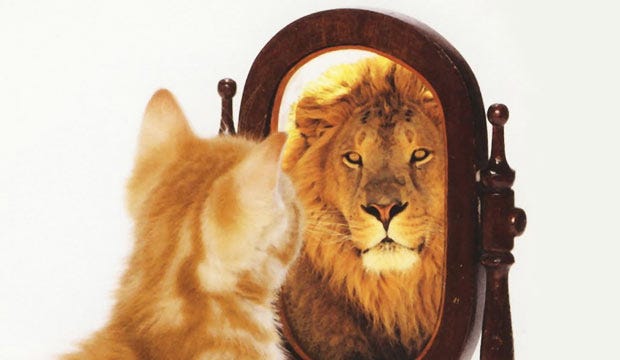
The constant dopamine releases from likes and retweets and subscriptions form an addiction in the Pandemic Pundit - and this change in brain chemistry affects their thinking, driving them to generate and post ideals and opinions that are increasingly more and more sadistic, deranged, and fictional. You can probably imagine who this describes in your head already - Vinay Prasad, the Great Barrington dickheads, Monica Ghandi to name a few.
They’re addicted to feeling like they’re a grand protagonist standing up against the medical tyranny of mask mandates, that they’re the real hero of the COVID story - not those silly doctors and nurses who are actually treating patients, or those pitiful researchers doing the boring work of developing new treatments and vaccines. Me and my posting, and my dedicated followers - we are the real heroes of this adventure! Don’t believe me? This is what mass-infection advocate and general plague rat of the Great Barrington Declaration, Martin Kulldorff, tweeted out recently:
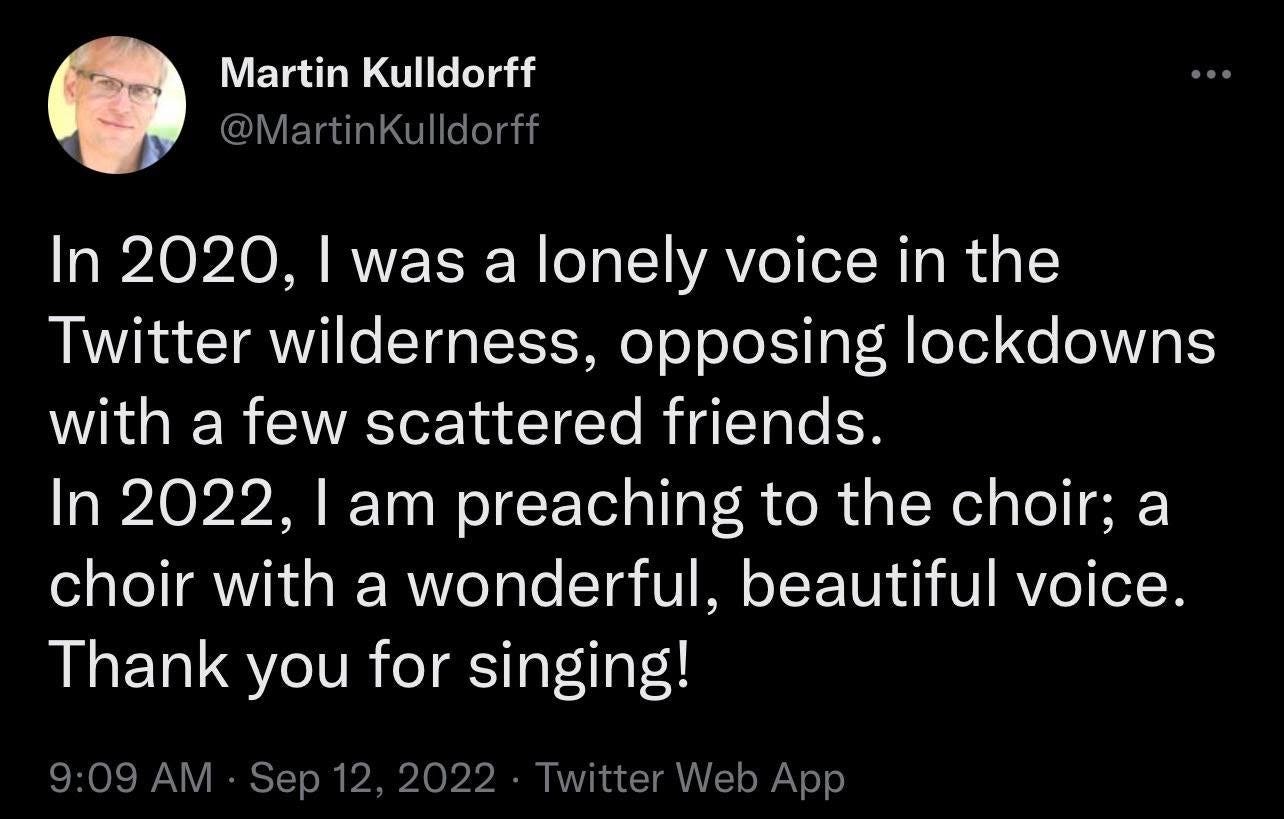
You know who else had a fucking choir, Martin?
Awkward. Yet, this is the fiction that these wannabe champions for truth and justice see themselves in. The valiant heroism… of posting words and videos on the Internet and pissing in the faces of very real heroes and defenders - whether it’s the frontline doctor who was driven past their breaking point in March 2020, or an activist and volunteer like Amanda Hu, who I greatly admire. They don’t get a parade, or a paid vacation, or any of the “epic loot” from doing the real fighting in this conflict of pestilence. They didn’t need to have their work “gamified” or turned into an addictive experience, driving them to become more and more unhinged and deranged. They simply rolled up their sleeves and did the right thing.
For these Pandemic Pundits, they may never be able to log off from this deadly game they’re so terribly addicted to. This global calamity of the COVID-19 pandemic, which has killed and crippled millions, will remain little more than a game in their pitiful minds, and they may never wake up to the reality of the countless harms they caused. Even funnier is how they’re often funded by far-right billionaires, who spend a great deal of money on “botfarms” - fake social media accounts to drive engagement and harass those would fight for the public’s health. So the Pandemic Pundit is actually getting spitroasted by their billionaire masters on both ends - both financially and emotionally, through astroturfed engagement. A truly pitiful sight.
I’m reminded of the fearmongering masterpiece that is Mazes & Monsters, the awe-inspiring Oscar-winning magnum opus starring the legendary Tom Hanks warning of the dangers of Dungeons & Dragons, but instead of a simple game centered around dice rolling and story weaving, they should have been warning off the dangers of spreading seductive fictions during a time of great calamity…
You see, the problem with being a leader that overserves your followers with intoxicating fiction, is that eventually the lights turn off, and the party’s over. The drugs wear off. And then… the hangover of reality begins to kick in. All of those joyful ballads and happy memories are followed with an overwhelming feeling of incredible sickness and disgust. As the sketchy dealer desperate to sell another fix, people might just start to rethink how they see you. Things typically don’t end well after that. Just ask good old Caesar…
Good night and good luck, comrades-in-corona. Life is hell, but the war continues.